Home Modifications & Hacks
When even one step is too much — ramps, zero-entry solutions, smart home, and practical house hacks for IBM patients
Ramps — Getting In and Out
A wheelchair ramp is the single most important modification for IBM patients. Without one, you're trapped inside your home. There are options for every situation.
Permanent Ramps
Concrete or Wooden Ramp (Custom Built)
Permanent ramp installed at your front door (and any other entry). ADA slope ratio is 1:12 — for every 1 inch of rise, you need 12 inches of ramp length. A 6-inch step needs a 6-foot ramp. Cost: $1,500-5,000 installed.
Modular Aluminum Ramp — ~$1,000-3,000
Pre-built sections that snap together. Can be installed in hours, removed if you move, and adjusted for different heights. No construction needed. Popular brands: Prairie View Industries, EZ-ACCESS. Available on Amazon and home improvement stores.
Portable Ramps
Threshold Ramps — ~$25-100
Small rubber or aluminum ramps that bridge the gap at door thresholds. Typically 1-6 inches high. Essential for every doorway in the house. No installation needed — just place them.
Folding Portable Ramp — ~$100-400
Folds in half for transport. Used for car trunks, visiting friends, restaurants. Lengths from 2-8 feet. Weight capacity 600-1000 lbs. Essential for any IBM patient who leaves the house.
Telescoping Ramp — ~$200-600
Extends and retracts to fit different heights. Great for curbs, single steps, and variable-height transitions. More expensive but extremely versatile.
Doorways & Zero-Entry Solutions
Zero-Entry Door Hinges
Standard door hinges leave a gap at the bottom and require pushing the door open wide enough for a wheelchair. Zero-entry (or offset) hinges mount the door on the frame edge, giving you the full doorway width without needing to widen the door frame.
Zero-Entry Hinges — ~$20-50 per set
Mount on the existing door frame, no construction needed. Gain 2+ inches of doorway width. The door swings clear of the frame, giving wheelchair users the full opening. Install in 30 minutes with a screwdriver.
Doorway Widening
Minimum 32" Clear Width
Standard doorways are 28-30 inches. Wheelchairs need 32 inches minimum. Options: remove the door entirely (free), use offset hinges (cheap), or hire a carpenter to widen the frame ($200-1,000 per doorway).
Door Closers and Openers
Automatic Door Opener — ~$200-500
Push-button or sensor-activated door openers for interior and exterior doors. Hold a fob or press a button and the door opens automatically. Essential for patients who can't push a door open with weak arms.
Lever Door Handles — ~$5-20 each
Replace all round doorknobs with lever-style handles. Levers can be operated with an elbow, fist, or weak hand. Round knobs require grip strength that IBM patients lose early. This is the cheapest, easiest mod you can make.
Stairs & Multi-Floor Mobility
If your home has stairs, you need a plan. Options range from simple to complex.
Stairlift — $3,000-15,000
Motorized chair that rides along a rail mounted to the stairs. Carries the patient up and down. For straight stairs: $3,000-5,000. For curved stairs: $10,000-15,000. Installation takes 1 day. Popular brands: Bruno, Harmar, Stannah.
Vertical Platform Lift (VPL) — $5,000-20,000
Like a small elevator for one or two floors. Wheelchair rolls directly onto the platform. More expensive than stairlifts but the patient stays in their wheelchair. Required for power wheelchair users who cannot transfer to a stairlift chair.
Ceiling Track Lift System — $3,000-10,000 installed
The best solution for multi-floor homes. A motorized lift on ceiling-mounted tracks that can move a patient between rooms — even through doorways using "Tarzan" portable track connections. Eliminates caregiver lifting entirely. SureHands, Prism Medical, and Handicare make these systems.
Single-Floor Living (Free)
The cheapest option: convert one floor of your home into a complete living space. Move the bedroom downstairs, set up a bathroom with roll-in shower, install a ceiling lift on that floor. Avoid the stairs entirely.
Kitchen Hacks
Height-Adjustable Counter — ~$200-800
Electric or manual sit-stand desk converters placed on existing counters. Allows a wheelchair user to roll under and work at the right height. Alternatively, lower one section of counter to 28-30 inches (wheelchair height) during a remodel.
Under-Cabinet Sink Modification for Wheelchair Access — ~$200-800
Cut out the cabinet under the sink so a wheelchair can pull right up to use it. This allows the patient to brush their teeth, wash hands, and access the sink from a seated position. The modification removes the base cabinet and plumbing access panel, leaving open knee space. A plumber may need to reroute pipes higher or to the back wall. This is one of the most impactful kitchen or bathroom modifications for wheelchair users.
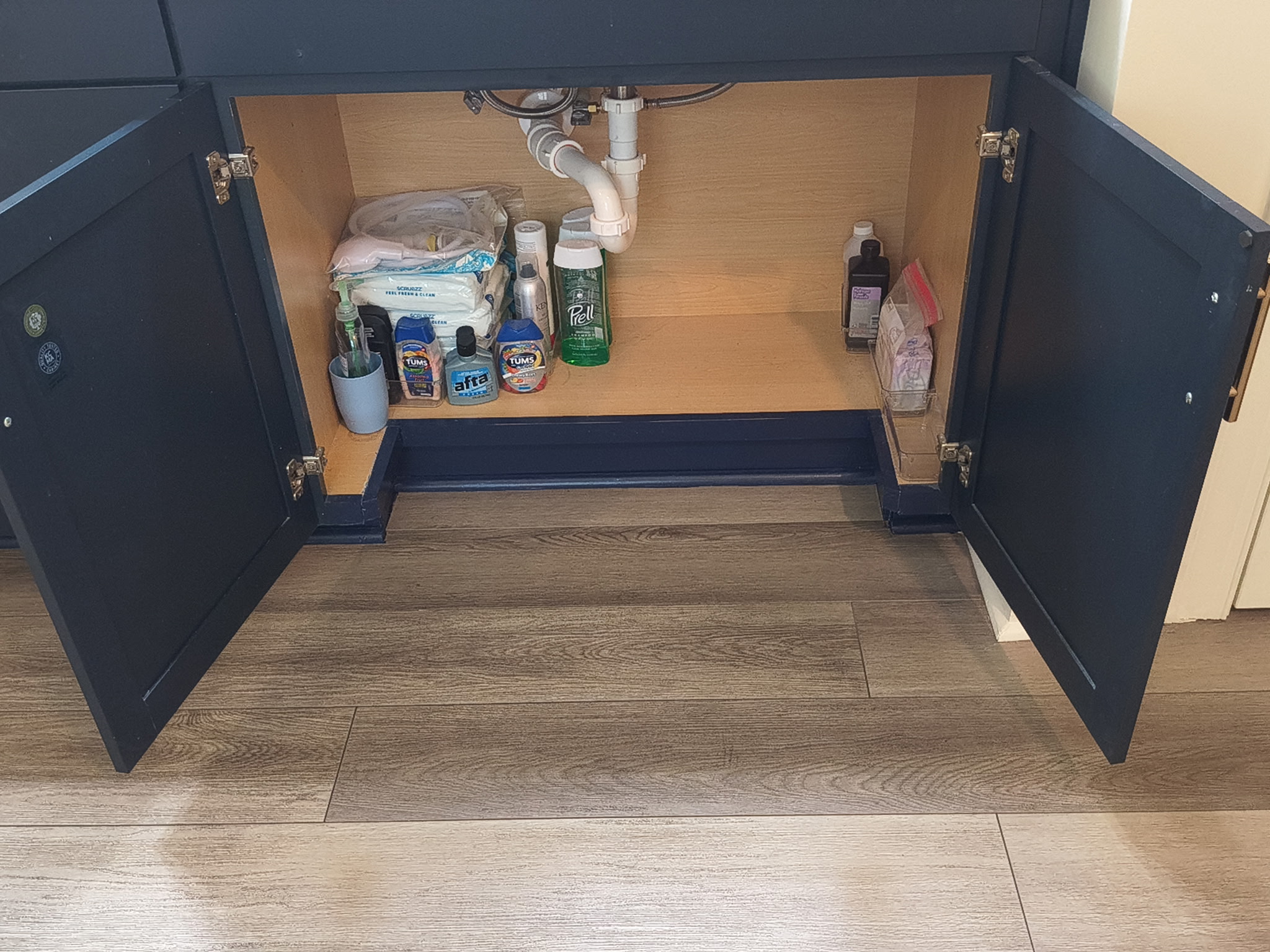
Example: Actual under-cabinet sink modification for wheelchair accessibility
Pull-Out Shelving — ~$30-100 per shelf
Slide-out shelves in lower cabinets eliminate the need to reach into dark cabinets. Pull the shelf out to you. Available at Home Depot, IKEA, or Amazon.
Lazy Susan / Turntable — ~$10-30
Put one in every corner cabinet and deep shelf. Spin to reach items instead of reaching into the back. The simplest kitchen hack that makes a huge difference.
D-Shaped Cabinet Handles — ~$3-10 each
Replace all round cabinet knobs with D-shaped bar pulls. Easier to hook a finger or fist through than to grip a round knob. Same concept as lever door handles.
Electric Can Opener / Jar Opener — ~$15-40
Push-button can openers and under-cabinet jar openers eliminate the need to grip and twist. Essential when hand strength is declining.
Rolling Kitchen Cart — ~$50-200
Mobile island on wheels that can be positioned where needed. Provides extra counter space at wheelchair height and can be rolled to the dining table.
Smart Home — Voice Control Everything
When you can't reach light switches, door locks, or thermostats, voice control becomes essential — not a luxury. A $30 smart speaker can change your life.
Amazon Echo / Google Home — $25-100
Voice-controlled speaker that can control lights, locks, thermostat, TV, and more. "Alexa, turn on the lights." "Hey Google, lock the front door." The single best investment for an IBM patient's independence.
Smart Light Bulbs — ~$10-30 per bulb
Replace all light switches with smart bulbs (Philips Hue, Wyze, TP-Link Kasa). Control by voice, phone, or automation. No more getting up to flip switches. Pair with smart switches for wall-mounted control.
Smart Door Lock — ~$100-250
Yale, August, or Schlage smart locks. Lock/unlock by voice, phone, or code. No more fumbling with keys. Let caregivers in remotely.
Smart Thermostat — ~$100-250
Nest or Ecobee. Control temperature by voice or phone. Never get up to adjust the thermostat again. Also saves energy.
Smart TV Remote / Fire Stick — ~$25-50
Voice-controlled TV. "Alexa, play Netflix." "Alexa, volume up." No more hunting for the remote or struggling with small buttons.
Bedroom Modifications
Adjustable Bed Frame — ~$300-1,500
Head and foot elevation via remote control. Sit up to read, eat, or watch TV without pillows. Critical for dysphagia — sleeping with head elevated reduces aspiration risk. Some models have built-in massage.
Hospital Bed — $500-5,000
Full-electric hospital bed with powered height, head, and foot adjustment. Essential for patients who need help getting in and out of bed. Medicare covers with physician documentation.
Bed Rail / Transfer Pole — ~$30-150
Grab bar that attaches to the bed frame. Gives the patient something to hold when rolling over or transferring. Transfer poles mount floor-to-ceiling and serve as a pivot point for standing.
Overhead Trapeze Bar — ~$50-200
A bar above the bed that the patient can grab to reposition themselves. Helps with rolling over and sitting up. Attaches to bed frame or wall.
Motion-Activated Nightlights — ~$10-20 for a pack
Plug-in or adhesive lights that turn on when they detect movement. No more fumbling for light switches in the dark. Install in hallway, bathroom, bedroom.
Bathroom Quick Reference
For full bathroom details, see the Bathroom & Toileting page. Here are the essential quick wins:
- Grab bars: $20-60 each — install near toilet, in shower, at entry (screw into studs!)
- Raised toilet seat: $25-100 — reduces transfer distance
- Shower chair: $50-300 — seated showering
- Handheld showerhead: $20-80 — direct water where needed
- Bidet seat: $41-550 — eliminates need for wiping
- Non-slip mats: $10-30 — essential safety
- Anti-scald valve: $30-100 — prevents burns from temperature spikes
Vehicle Modifications
Wheelchair Accessible Van — $30,000-80,000+
Full-size van with lowered floor, ramp, and wheelchair tie-down. The gold standard for wheelchair users who travel. Companies: BraunAbility, Vantage Mobility, Mobility Works. Some states offer financial assistance.
Portable Ramp for Car — $100-400
Folding ramp to get wheelchair in/out of a van or SUV. Lighter and cheaper than a full van conversion. Works with standard minivans.
Hand Controls — $500-2,000 installed
For patients who can still drive but can't use foot pedals. Hand-operated accelerator and brake. Contact your state's vocational rehabilitation program for evaluation and funding.
Seat Swivel — ~$200-500
Turns the driver or passenger seat to face outward, making it easier to transfer in and out of the vehicle. Power or manual versions available.
Free or Cheap Hacks
Not everything needs to cost money. These simple changes make a big difference:
- Remove all throw rugs — Tripping hazard and wheelchair obstacle (free)
- Clear pathways — Move furniture to create 36" wide paths through the house (free)
- Remove closet doors — Bi-fold doors block wheelchair access. Take them off (free)
- Lower closet rods — Move hanging clothes to wheelchair-reachable height (free)
- Use reaching tools — $10 grabber tools eliminate bending and reaching (cheap)
- Magnetic knife strip — Wall-mounted, no drawer access needed ($10-20)
- Velcro everything — Velcro strips for remote controls, phones, tools — keep them where you need them ($5)
- Bedside caddy — Hangs on bed rail, holds phone, remote, water, meds ($15-25)
- Shower caddy on chair — Attach to shower chair so supplies are within reach ($10)
- String on zippers — Tie a loop of string to zipper pulls for easier gripping (free)
- Grooved door handles — Wrap rubber bands around smooth handles for better grip (free)
Modification Costs at a Glance
| Modification | Cost Range | Covers |
|---|---|---|
| Lever door handles | $5-20 each | Every door |
| Threshold ramps | $25-100 each | Every doorway |
| Grab bars | $20-60 each | Bathroom, shower |
| Zero-entry hinges | $20-50 per set | Narrow doorways |
| Motion nightlights | $10-20 pack | Hallways, bedroom |
| Smart speaker | $25-100 | Whole house voice control |
| Portable ramp | $100-400 | Car, visits, restaurants |
| Adjustable bed frame | $300-1,500 | Bedroom |
| Stairlift | $3,000-15,000 | Stairs |
| Ceiling lift | $3,000-10,000 | Whole floor |
| Wheelchair van | $30,000-80,000+ | Transportation |